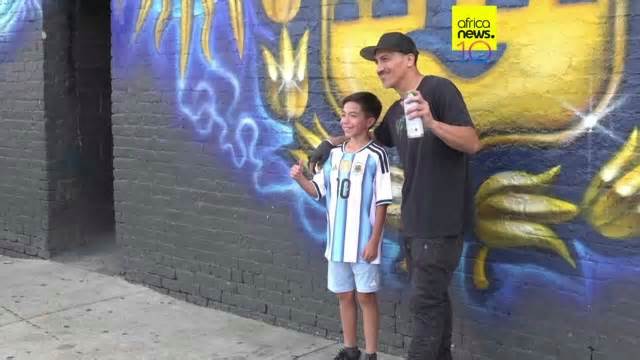
Dallas artist unveils mural paying tax to Argentina and Lionel Messi

By Emma González
Dallas artist unveils mural paying tax to Argentina and Lionel Messi

Image: MSN

The spray paint was still settling on the brickwork of a nondescript Dallas wall when the latest testament to the cult of Lionel Messi was unveiled—a vibrant homage bridging the gap between North Texas and the pampas of Argentina. The mural, a towering, stylized portrait of the Rosario-born captain, serves as more than mere street art. It acts as a modern totem, capturing the fervor of a global fanbase that views the footballer not merely as an athlete, but as a secular deity of the twenty-first century.

Dallas, a city traditionally defined by industrial ambition and an obsession with the gridiron, has become an unlikely nexus for this international devotion. The mural features bold, saturated hues that evoke the colors of the *Albiceleste*, drawing passersby into a quiet, meditative space amidst the urban rush. As fans gather to pose for photographs, the artwork transforms the local streetscape into a pilgrimage site, reflecting the sheer velocity at which Messi’s brand has permeated the American cultural consciousness.

This phenomenon does not occur in a vacuum. The cultural landscape of North Texas has been significantly reshaped by a demographic shift that mirrors broader trends across the Americas. Dallas sits at a crossroads where Latin American influence is increasingly woven into the municipal fabric, much like the cultural exports arriving from throughout the hemisphere, where a deep-seated passion for *fútbol* functions as a primary language of social cohesion. The mural stands as a physical manifestation of this regional evolution, acknowledging that the borders of Messi’s influence now extend far beyond the pitch in Buenos Aires. Historically a frontier of cattle trails and oil booms, the region is now being redrawn by the arrival of global icons whose narratives resonate deeply within its diverse, modern populace.

Public reaction has been swift and visceral. Local residents and international observers alike have praised the work for its ability to distill the complex, often chaotic emotion of the 2022 World Cup victory into a singular, static image. Critics note that the artist’s decision to eschew traditional realism in favor of a more expressive, iconographic style aligns with how Messi is perceived in his home country: as a symbol of resilience, grace, and the possibility of triumph against overwhelming odds.

The significance of this mural, however, transcends the aesthetic or the athletic. In an era often defined by political fracture and isolationism, Messi functions as one of the few truly unifying symbols in global popular culture. Whether in the bustling neighborhoods of Montevideo, the high-rises of Doha, or this quiet corner of Dallas, the Argentine star has become a common denominator—a figure whose identity is simultaneously hyper-local to Rosario and universally accessible. As this mural anchors itself into the concrete of Texas, it suggests that the geography of fandom has been permanently altered. We are witnessing the solidification of a new, borderless iconography where the devotion to a single human being serves as the glue for a fragmented world, proving that even in the heart of the American South, all roads eventually lead to the blue and white stripes of the Argentine captain.