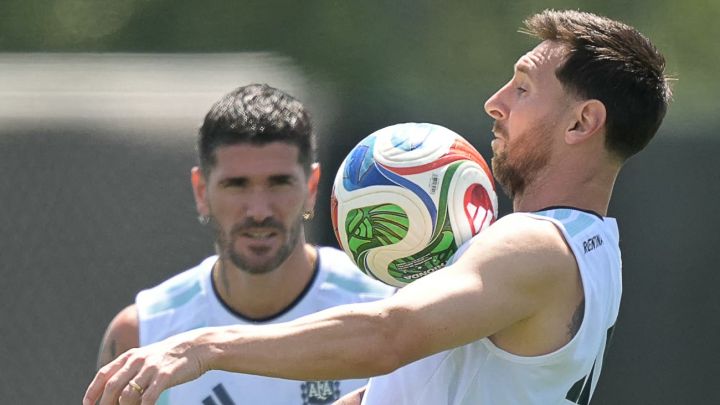
Unstoppable Messi hits another high with Selección’s solid support

By Emma González
Unstoppable Messi hits another high with Selección’s solid support

Image: Buenos Aires Times

The air inside the Estadio Monumental in Buenos Aires does not simply vibrate when Lionel Messi touches the ball; it exhales, a collective release of tension that has defined the Argentine psyche for nearly two decades. In his latest masterclass for *La Selección*, Messi did not merely secure another victory; he solidified a status that has transitioned from national hero to secular saint. As he glided past defenders with a fluidity that defies his age, it became clear that this is no longer the story of a solitary genius burdened by a nation’s expectations. Instead, it is the zenith of a symbiotic evolution, where Messi’s individual brilliance finally finds its perfect mirror in the rigorous, selfless tactical structure of his teammates.

For years, the narrative surrounding the national team was one of tragic dissonance. Historically, Argentina’s football identity has been rooted in the *pibe* archetype—the scrappy, imaginative street footballer—often resulting in a chaotic reliance on individual talent at the expense of defensive cohesion. Following the dark years of the 1990s and early 2000s, which saw a series of heart-wrenching tournament exits, the current iteration of the squad represents a radical departure. Under the stewardship of the current coaching staff, the team has abandoned the frantic individualism of the past, opting instead for a disciplined, industrial work ethic that creates the space for Messi to operate with surgical precision.

This shift has not gone unnoticed across the continent. In neighboring Brazil, where the rivalry with Argentina is forged in a shared obsession for the "beautiful game," analysts have remarked on the newfound maturity of *La Scaloneta*. While Brazil grapples with the transition of its own attacking generation, the Argentine model—a rigid, functional engine room supporting a singular, creative spark—is being studied with a mixture of envy and begrudging respect. The regional dominance currently held by Argentina is not just a product of one man’s vision, but of a functional, collective humility that permeates the entire dressing room.

The public reaction in the streets of Buenos Aires reflects this transformation. Outside the stadium, fans no longer chant for Messi to "save them" as they once did; they sing of a team that belongs to everyone. The murals that adorn the city walls, once depicting a solitary Messi staring toward the heavens, are being reimagined to include the silhouettes of his teammates, representing a unified front that captures the pride of a nation currently navigating profound economic volatility.

The significance of this era extends far beyond the confines of a pitch. In a country that has long struggled with internal fragmentation and the weight of its own history, the national team has become a rare, unifying institution. Messi, now the steward of this legacy, serves as the bridge between the erratic brilliance of Argentina’s past and the disciplined, collective confidence of its future. As he continues to reach these new heights, he is not just tallying statistics; he is anchoring a culture that has finally learned how to support its greatest light, ensuring that when the history of this sport is written, it will be remembered not for one man’s solitude, but for the harmony of the squad he helped to build.