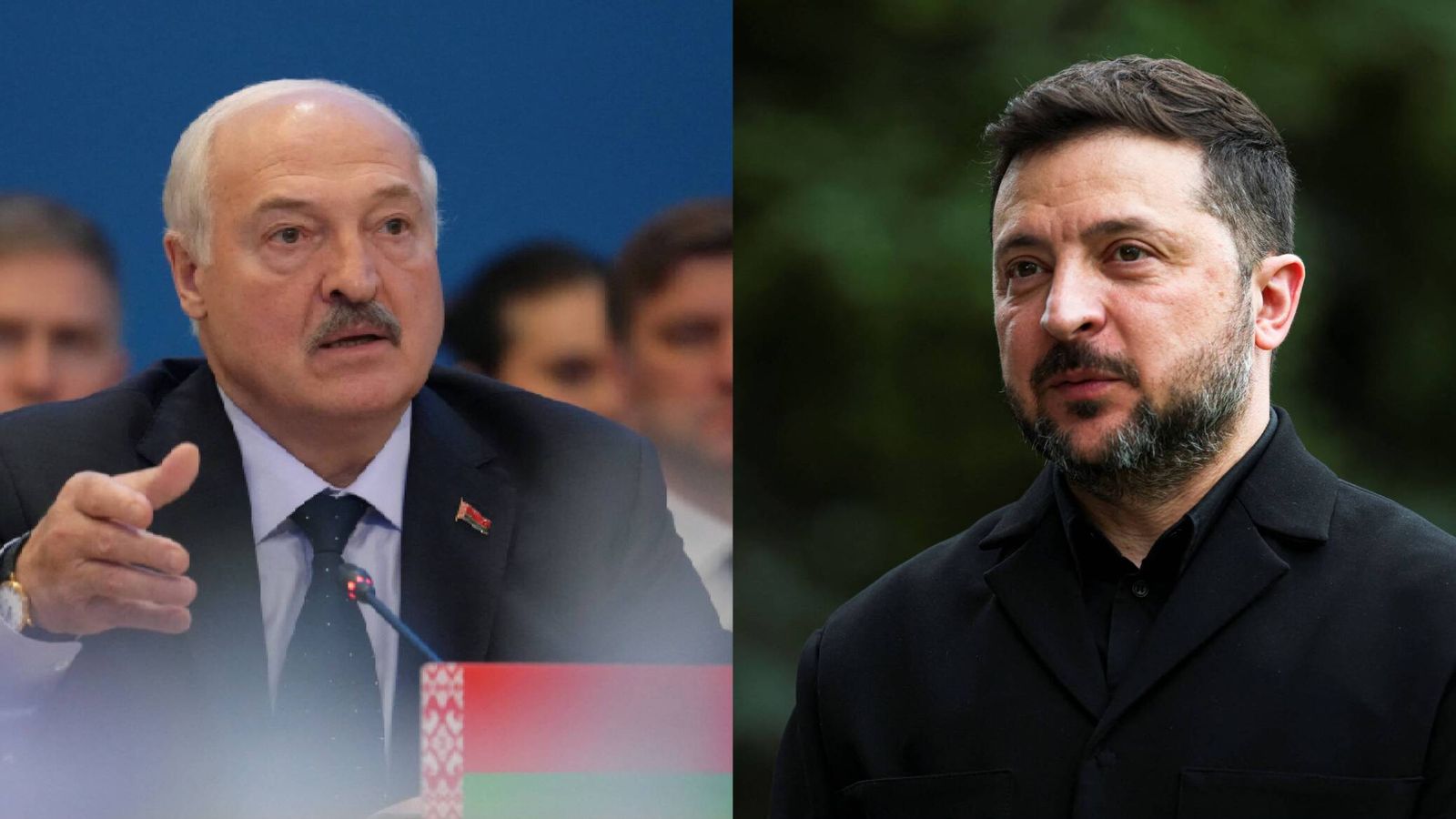
Zelensky gives Belarus a week to quet relaying Russian drones
Belarus
Image: Sky News
Can a seven-day deadline force a sovereign state to sever its military integration with a nuclear-armed neighbor without triggering a wider conflagration? Ukrainian President Volodymyr Zelensky’s recent ultimatum to Minsk to halt the relaying and launch of Russian drones crystallizes the precarious geometry of Eastern Europe’s ongoing war, transforming a tactical grievance into a high-stakes test of regional deterrence. By demanding that Belarus dismantle its role as an aerial staging ground for Moscow, Kyiv seeks to redraw the boundaries of permissible conflict participation while pushing Alexander Lukashenko’s regime into an increasingly untenable diplomatic position.
From Kyiv’s perspective, the deadline is a calibrated escalation driven by immediate operational necessity. Ukrainian defense officials argue that Iranian-made Shahed loitering munitions routinely traverse Belarusian airspace to strike Kyiv and northern industrial centers, effectively rendering Minsk a co-belligerent in all but name. Western security analysts, however, caution that public ultimatums may corner the Belarusian leadership into rhetorical defiance rather than tactical recalibration. “An ultimatum this explicit removes the diplomatic off-ramps that Minsk has traditionally relied upon,” noted a senior NATO-affiliated strategist. Meanwhile, Belarusian state media has consistently characterized its military coordination with Russia as a legitimate domestic security measure, dismissing Ukrainian allegations as a pretextual tactic meant to stretch Kyiv’s overburdened air defenses.
This confrontation echoes a regional geography long shaped by great-power buffer dynamics. During the Cold War, Belarusian territory served as a critical forward operating zone for Warsaw Pact forces, a strategic posture that endured well after Minsk declared independence from the Soviet Union in 1991. That geopolitical dependency deepened following the political unrest of 2020, when bilateral security pacts with Moscow were rapidly accelerated to ensure regime survival. Today, the shared 1,084-kilometer border has again become a primary vector for aerial warfare. Open-source monitors have documented hundreds of drone incursions originating from the north since Russia launched its full-scale invasion in February 2022. The spillover risks extend well beyond Ukraine’s borders: neighboring Poland, a key NATO ally that shares a frontier with Belarus, has already escalated air policing operations and reinforced its eastern military command. These developments underscore how Kyiv’s deadline directly tests the resilience of Europe’s collective defense framework.
The geopolitical fallout will ultimately depend on how Moscow, Minsk, and Kyiv interpret the expiration of the clock. If Belarus disregards the ultimatum, Kyiv will face mounting domestic pressure to strike Belarusian logistics corridors—a move that could shatter the already fragile tacit rules of engagement and trigger accelerated NATO contingency deployments. Should Minsk attempt only partial compliance, it risks disrupting integrated military supply chains with Russia, potentially inviting covert Kremlin retaliation or intensified economic coercion. A third trajectory envisions Belarus leveraging the standoff to broker a broader de-escalation framework, using the specter of Ukrainian strikes as leverage to extract Western sanctions relief while quietly throttling drone transit volumes. In a theater where aerial warfare routinely blurs the line between proxy action and direct confrontation, the coming week will measure not merely flight paths, but the structural resilience of Eastern Europe’s security order.